
CNCBT Academy Training Page
Practice The Two-Phase CNCBT Learning Loop
Choose one AARV(4) skill, choose a safe movement platform, train for 8 minutes, then enter Reflective Stillness to review, internalize, and record what you learned.
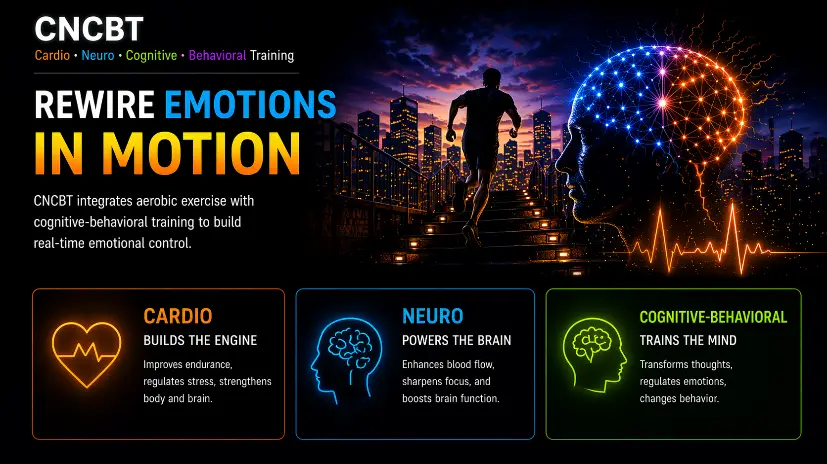
0:30
Prepare
4:30
Move + Train
3:00
Reflective Stillness
On this page
From story to practice
This page turns CNCBT into a guided practice space.
The Home page tells how the training began. The CNCBT page explains the two-phase learning loop. The Book page organizes the story into chapter-end practice. The Deep Dive page shows the training data, recall practice, six-ascent cycle, and 5-Level Emotional Regulation Scale. This Training page brings those pieces together as an interactive practice hub.
What Visitors Can Do Here
- Choose one AARV(4) skill or the combined sequence.
- Practice on a safe movement platform, not necessarily stairs.
- Use the 0:30 / 4:30 / 3:00 timer structure.
- Enter Reflective Stillness, rate ERS, and record a practice log.
- Export the log for future workbook or app development.
The CNCBT training rhythm
One 8-minute session. Two phases. Five learning steps.
Each CNCBT session begins with brief preparation, then moves through an Active Movement Phase and a Reflective Stillness Phase.
0:30
Prepare & Set Intention
Review the selected skill and decide how you will practice it today.
4:30
Active Movement Phase
Encode the cue, embody it while moving, and retrieve it repeatedly from memory.
3:00
Reflective Stillness Phase
Reflect on what happened and internalize the lesson in your own words.
Encoding loads the skill into memory as a clear script or cue.
Embodying applies the skill while the body is moving, breathing, and physically activated.
Retrieval strengthens access by repeatedly pulling the skill back from memory during practice.
Reflection reviews what happened, what went well, where focus was lost, and what needs more practice.
Internalization turns the lesson into your own words, cue, phrase, or next-step plan.
Choose a safe platform
The active movement phase is not limited to stairs.
Visitors can choose a medically appropriate and physically safe exercise platform. The goal is not the equipment itself; the goal is practicing the skill while the body is safely activated through movement.
🚴
Stationary Bike
Stable, adjustable, and useful when stair climbing is not available or safe.
🏃
Treadmill or flat track
Good for controlled pace, power walking, and steady breathing practice.
Trail walking
Outdoor movement with natural variation, grounding, and attention practice.
⚙️
Elliptical
Lower-impact rhythmic movement for encoding, breathing, and retrieval.
Stair climbing
The original self-study platform, but not required for CNCBT practice.
Safety first: Choose an activity that fits your health status, age, fitness level, balance, joints, and environment. Stop if you feel chest pain, faintness, severe shortness of breath, or unusual symptoms. Seek medical clearance before physically demanding training.
Interactive practice app
8-Minute CNCBT Trainer
Select a skill and platform. The timer guides you through preparation, Active Movement, and Reflective Stillness.
Quickly review Awareness and set your intention.
Awareness script
Notice the trigger, body cues, behavioral urges, emotions, and thoughts before reacting.
Ready. Confirm the safety guidance to begin.
Record what you noticed, your ERS ratings, and one cue you want to internalize.
AARV(4) skill practice library
Five learning sequences plus the combined review
Awareness teaches the full learning model. The other skills use the same 8-minute structure without repeating the same explanation.
First A of AARV(4)
Awareness
Notice before reacting.
Prepare
Clear your intention. Review the cue: trigger, body, behavior, emotion, thought.
Active movement
While moving, ask: What is happening in my body? What am I feeling? What am I thinking? What am I about to do?
Reflect
Which cue appeared first? Where did I stay aware? Where did I lose awareness?
Internalize
When I feel chest tightness, heat, or the urge to interrupt, I will pause, scan, name, and choose.
Second A of AARV(4)
Acceptance
Own the response.
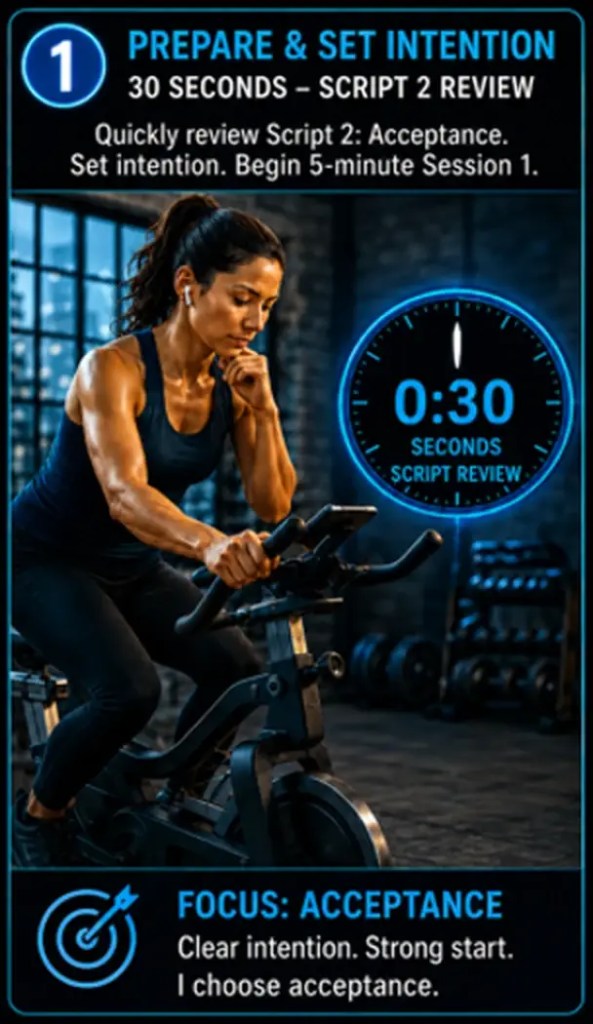

Prepare
Acceptance is not approval, agreement, or surrender. It means recognizing that activation is happening inside you.
Active Movement
Stay with discomfort instead of fighting it. Practice: This is my fight-or-flight response, and I can work with it.
Reflect
What did I resist? Did I blame the situation, the emotion, the body, or another person?
Internalize
This activation is happening in me. I can own it, slow down, and choose my next step.
R of AARV(4)
Relaxation
Breathe. Release. Ground. Stay steady.

Prepare
Relaxation means regulating the body while staying alert, not becoming passive.
Active Movement
Notice breathing, shoulders, jaw, hands, posture, and pace. Practice regulation inside activation.
Reflect
Where did I hold tension? Did I lengthen my exhale? Which body cue helped me calm down?
Internalize
When my breathing speeds up and my shoulders tighten, I will lengthen my exhale and ground my body before speaking.
V(4), Steps 1 and 2
Active Listening + Accurate Reflection
Understand before responding.
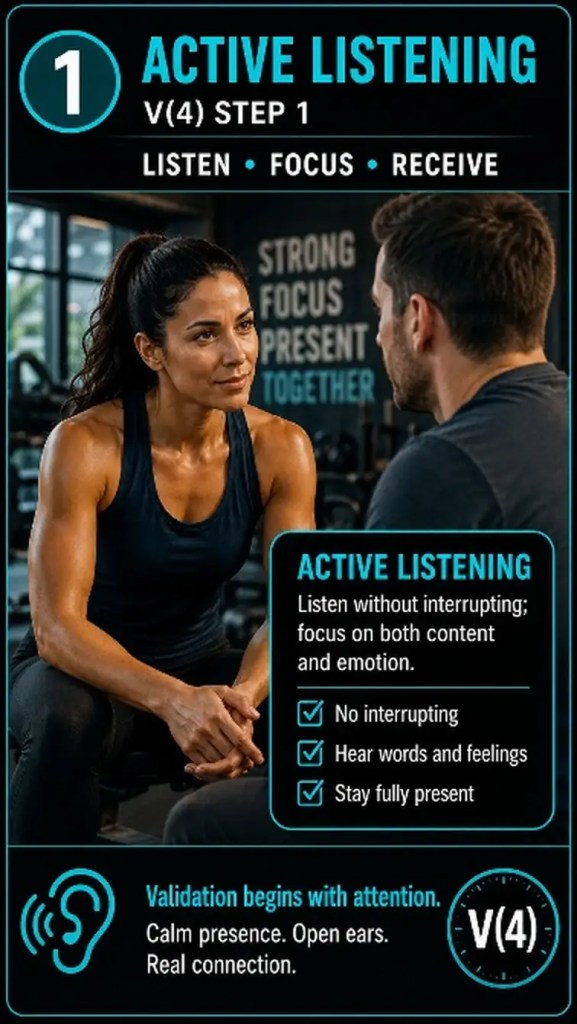

Prepare
Set the intention: I will listen first, notice emotion, reflect accurately, and check understanding.
Active Movement
Rehearse staying open while activated. Notice the urge to interrupt, defend, correct, or prepare a comeback.
Reflect
Did I mentally interrupt? Did I reflect both content and emotion? Did I add my interpretation too quickly?
Internalize
When I feel defensive, I will pause, listen first, and reflect the other person’s words and emotion before explaining my position.
V(4), Steps 3 and 4
Normalization + Problem-Solving
Validate first. Solve second.

Prepare
Review the sequence: validate what makes sense, find the shared goal, choose one next step.
Active Movement
Practice moving from empathy to action without rushing, dismissing, arguing, or fixing too quickly.
Reflect
Did I validate before solving? Did I identify a shared goal? Did I name one concrete next step?
Internalize
When someone is upset, I will first acknowledge why it makes sense, then ask what we both want and suggest one next step.
Full AARV(4) review
Combined Sequence
Notice. Own. Regulate. Understand. Validate. Move forward.
Awareness
Notice activation before reacting.
Acceptance
Own the fight-or-flight response.
Relaxation
Calm the body while staying alert.
Listening + Reflection
Understand before responding.
Normalization + Problem-Solving
Validate what makes sense and choose one next step.
Deep Dive training structure
Six-ascent cycle, adapted for any safe platform
The original self-study used six ascents of a 21-floor stairwell: one AARV(4) skill per ascent, then a final combined review. On the Training page, this becomes a flexible six-block practice cycle that can be adapted to stationary bike, treadmill, trail walking, elliptical, flat-track walking, or stairs.
Block 1
Awareness
Notice body cues, behavioral urges, emotions, and thoughts before reacting.
Training cue: Notice before reacting.
Block 2
Acceptance
Recognize the fight-or-flight response and take responsibility for your next response.
Training cue: This activation is mine to manage.
Block 3
Relaxation
Use breathing, posture, grounding, and tension release to calm the body while staying alert.
Training cue: Breathe, release, ground, stay steady.
Block 4
Active Listening + Accurate Reflection
Listen without interrupting, then reflect content and emotion without distortion.
Training cue: Listen first, reflect clearly.
Block 5
Normalization + Problem-Solving
Recognize what makes sense in context, then move toward a shared goal and next step.
Training cue: Validate first, solve second.
Block 6
All Combined
Bring all skills together as one cohesive AARV(4) practice sequence.
Training cue: Notice, own, regulate, understand, validate, move forward.
Track the practice
5-Level ERS + Reflection Log
The 5-Level Emotional Regulation Scale is a structured, skill-based SUDS. It turns emotional regulation into a repeated self-monitoring pattern: notice, rate, record, review, and adjust.
Private By Default On This Device
Your practice logs are stored only in this browser using local storage. CNCBT Academy does not receive or transmit them. On a shared device, export anything you want to keep and then clear the saved logs.
Select today’s ERS rating
Choose a level after a practice session or emotional event.
Saved practice log
No practice logs yet.
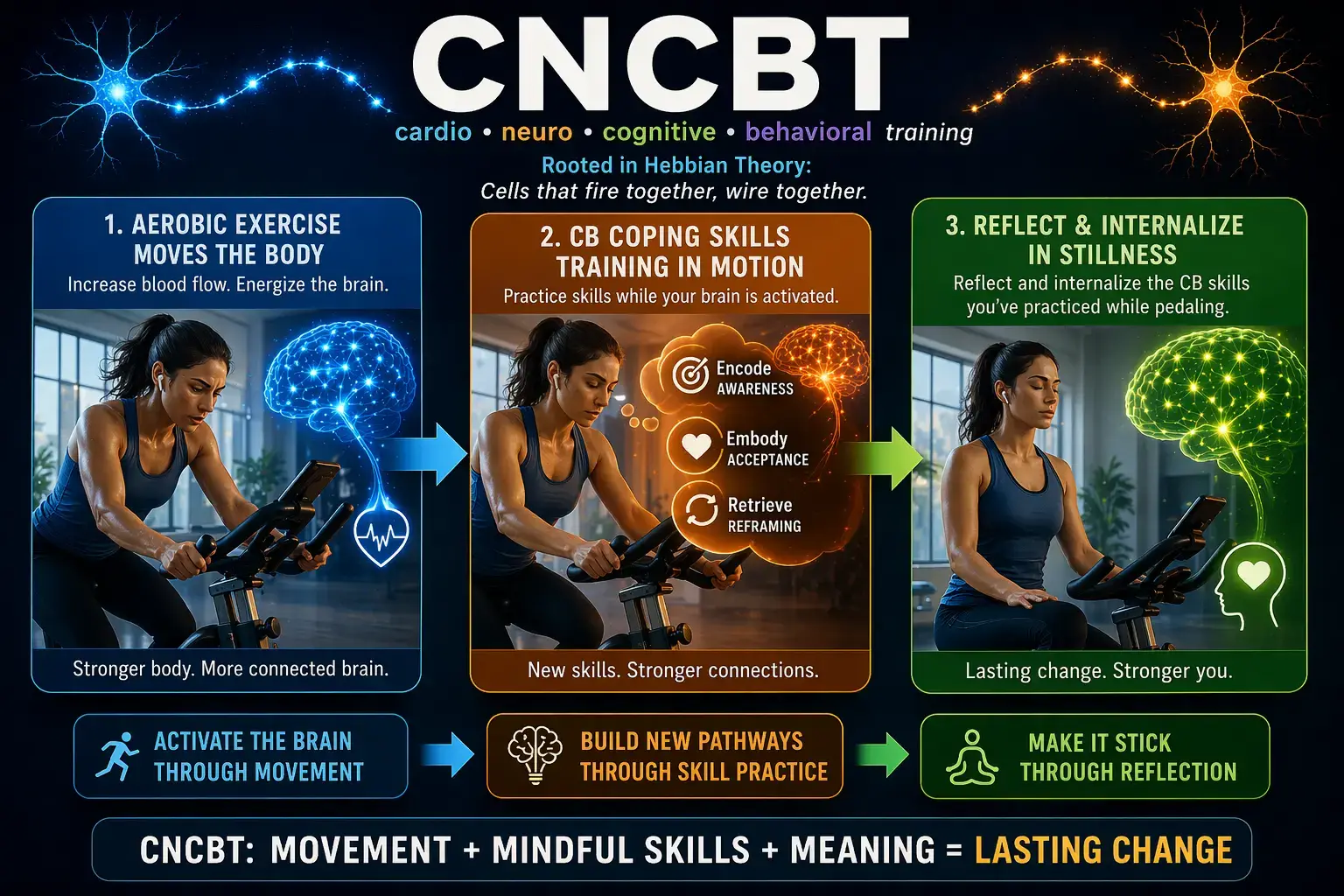
CNCBT Learning Loop
Movement trains the skill. Reflective Stillness makes it personally usable.
CNCBT is built on a repeated two-phase learning loop. During the Active Movement Phase, you practice an AARV(4) skill on a safe exercise platform of your choice. You encode the skill, embody it through movement, and retrieve it repeatedly from memory. After movement, you shift into the Reflective Stillness Phase, where you review what happened and turn the lesson into your own words, cues, or next-step plan.
Across the full AARV(4) sequence, Awareness helps you notice activation, Acceptance helps you own your response, Relaxation helps you regulate the body, Active Listening + Accurate Reflection helps you understand before responding, and Normalization + Problem-Solving helps you validate what makes sense and move toward constructive action.
Educational and safety disclaimer
CNCBT and AARV(4) are presented here as educational training materials based on a single-case personal self-study and practice record. They are not a scientifically validated treatment, medical advice, psychotherapy, or a substitute for professional care. Physical training can be demanding; consult a qualified healthcare professional before beginning, especially if you have cardiovascular, respiratory, neurological, orthopedic, balance, or other health concerns.