
CNCBT Academy Deep Dive
Deep Dive Into Cardio-Neuro-Cognitive-Behavioral Training
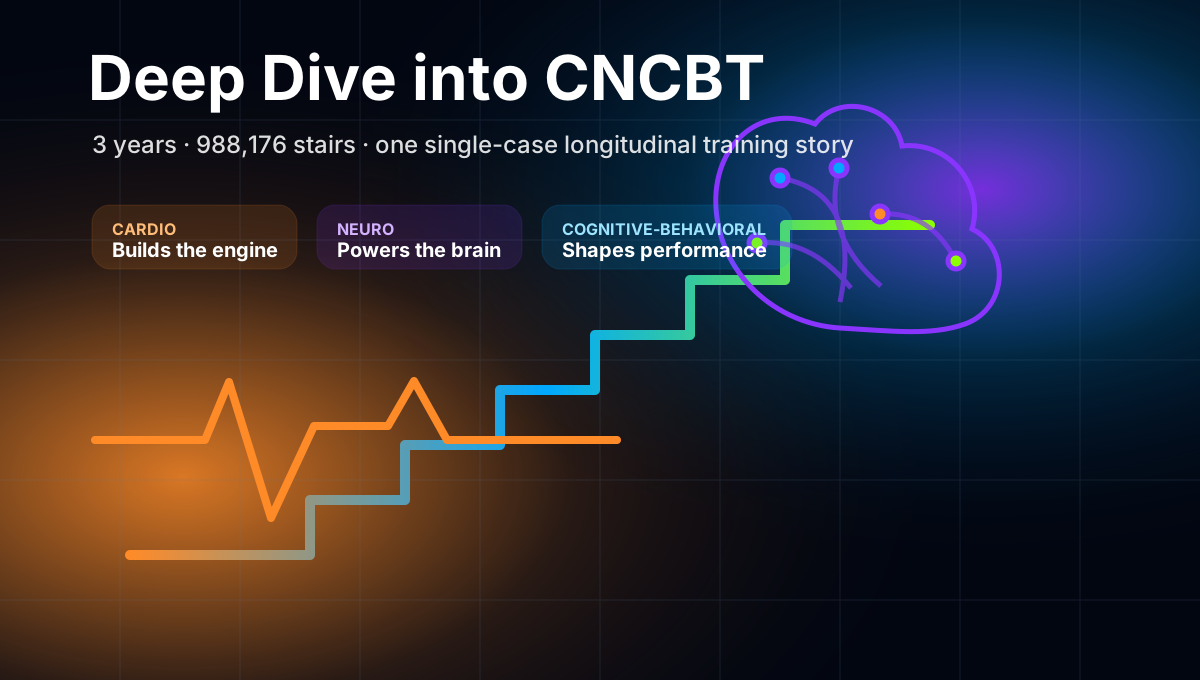
A data-informed look at how three years of stair-climbing training, recall practice, and AARV(4) skill rehearsal came together in one single-case longitudinal self-study.
Educational scope: CNCBT is presented here as a personal training model and self-observation record, not as a scientifically validated treatment or medical protocol.
Three-year training load
3 Years. 988,176 Stairs.
What changed after three years of stair-climbing training? The answer is organized into three domains: cardiovascular, neurological, and cognitive-behavioral.
Total ascents
2,941
21-floor ascents
Total floors
61,761
floors climbed
Total stairs
988,176
Total time
177:18:46
hh:mm:ss
The Training
How the CNCBT story began to take shape
I started stair training in the 21-floor apartment where my family lived during my tenure with SOCKOR. My first goal was concrete: reduce LDL cholesterol and improve physical fitness.
From January 3, 2019, to December 31, 2021, I tracked my workouts in Excel spreadsheets. Those records unexpectedly became more than fitness logs. They helped me articulate a story I had been pursuing for two decades: the integration of aerobic exercise with cognitive-behavioral training.
Training frame
CNCBT later became the name for this integration: cardiovascular exercise, memory practice, skill rehearsal, reflection, internalization, and behavior change.
- Cardio strengthened the engine.
- Recall practice trained attention and memory.
- AARV(4) trained emotional regulation and communication.
Section 1 · Cardio
Cardio Builds the Engine
The cardio layer of CNCBT is represented by the three-year 21-floor stair-climbing record. The table below summarizes the primary training load.
| Metric | Unit | 2019 | 2020 | 2021 | 3-Year Total |
|---|---|---|---|---|---|
| Total 21-SCE ascents | Ascents | 775 | 1,014 | 1,152 | 2,941 |
| Total floors | Floors | 16,275 | 21,294 | 24,192 | 61,761 |
| Total stairs | Stairs | 260,400 | 340,704 | 387,072 | 988,176 |
| Total time | hh:mm:ss | 54:29:08 | 55:31:03 | 67:18:35 | 177:18:46 |
| Average time/run | mm:ss | 04:23 | 03:20 | 03:28 | 03:44 |
The journey began with a single step
Over three years, the training totaled 988,176 stairs, or 61,761 floors—roughly equivalent to ascending the Empire State Building 605.5 times.
Health marker changed
In my personal records, LDL cholesterol decreased from 167.7 mg/dL to 103.4 mg/dL over 18 months, alongside exercise and dietary change, with no medication used.
From exercise to system
Cardio training became the platform for cognitive learning, skill rehearsal, and the later development of CNCBT.
Section 2 · Neuro
Neuro Powers the Brain
Between April–September 2019 and April–October 2021, I used stair climbing as a structured recall-training platform. During each climb, I listened to lectures from An Economic History of the World since 1400 and practiced encoding, rehearsal, and retrieval.
| Metric | 2019 Apr–Sep |
2021 Apr–Oct |
Interpretation |
|---|---|---|---|
| Average recall at start | 22.3 | 43.6 | Higher starting baseline in 2021 |
| Average recall at peak | 49.8 | 55.8 | Improved maximum retrieval capacity |
| Average recall at end | 47.9 | 55.8 | Stronger retention across the training period |
| Largest single-session recall | 80 | 73 | High peak performance maintained |
| Smallest single-session recall | 4 | 19–30 | Improved minimum performance range |
| Total training ascents during recall period | 508 | 643 | Increased exposure to training cycles |
| Recall consistency | Variable | More stable | Reduced performance fluctuation |
Note: Recall exercise was skipped in August 2021 due to severe weather conditions inside the stairwell.
Cardio load
21-floor climbing
Cognitive encoding
Learn and organiz
Retrieval under fatigue
Recall after ascent
Neural reinforcement
Repeat the cycle
Efficiency & stability
Improve over time
Recall vs AARV(4)
Memory-centered learning became skill-automation learning
The recall exercises helped prepare my brain to become more receptive to AARV(4) coping skills by strengthening cognitive endurance, attentional control, and retrieval under pressure.
World economic history training
Encoding → Rehearsal → Retrieval
Memory-centered learning: the goal was to take in information, rehearse it while climbing, and recall it at the top before it faded.
AARV(4) training
Encoding → Embodying → Retrieval → Reflection → Internalization
Skill-automation learning: the goal was to encode coping scripts, embody them through breath, posture, and behavior, retrieve them under activation, and internalize them as usable responses.
Section 3 · TOVA
TOVA Attention Test
The Test of Variables of Attention is a computerized attention measure often used in clinical assessment contexts. Here, the scores are presented only as part of my personal training record.
| Metric | 2019 07/09/2019 | 2020 07/07/2020 | 2022 07/12/2022 | Interpretation |
|---|---|---|---|---|
| Attention Performance Index | 3.96 | 5.14 | 4.31 | Improved overall attention; maintained above baseline |
| D Prime, Half 2 | -0.14 | 0.33 | 0.00 | Better signal detection, later normalized |
| Response-time variability, total | 111 | 117 | 109 | Improved consistency by 2022; lower is generally better |
| Response time, total | 143 | >140 | 139 | More controlled processing pattern |
| Commission errors, total | 99 | 109 | 103 | Stable accuracy pattern |
| Omission errors, total | 105 | 105 | 105 | Stable sustained attention pattern |
Together, the data suggest a plausible association between repeated aerobic exertion, cognitive-load training, and improved attention stability in this single-case record. They do not establish causation.
Section 4 · One Million Stairs Later
The effects of exercise, memory, and AARV(4) practice
Over three years, I climbed nearly one million stairs while training my brain at the same time. The stairs became more than exercise: they became a moving classroom and later a training ground for emotional regulation.
In simple terms, CNCBT helped me train brain and body together. Stair climbing strengthened the body. Recall practice strengthened attention and memory. AARV(4) strengthened emotional regulation through repeated practice.
Section 5 · AARV(4) CBT Training
Cognitive-behavioral task shapes performance and emotion
AARV(4) training used a six-ascent structure. Each ascent became a practice block for one skill or skill cluster, followed by reflection and internalization.
Exercise
Six ascents of 21 floors, repeated on each training day.
Duration
Approximately four minutes per ascent.
AARV(4) task
Awareness; Acceptance; Relaxation; Active Listening + Accurate Reflection; Normalization + Problem-Solving; all combined.
Reflection
Post-ascent self-evaluation, error correction, and cognitive restructuring.
Internalization
Organizing the trained skills into a personally meaningful sequence.
Section 6 · Six-Ascent Cycle
AARV(4) Six-Ascent Training Cycle
The six-ascent model organized each training day into a sequence of focused skill blocks.
Awareness
Identify situations that resemble previous anger triggers and focus on bodily, behavioral, emotional, and cognitive cues.
Acceptance
Acknowledge discomfort from the fight-or-flight response and recognize the response as yours to manage.
Relaxation
Use breathing, facial tension release, posture, vocal control, and grounding to soothe the sympathetic nervous system.
Active Listening + Accurate Reflection
Listen without interrupting, then summarize and mirror the other person’s thoughts and feelings without distortion.
Normalization + Problem-Solving
Affirm what makes sense in context, define a shared goal, and discuss concrete next steps.
All Combined
Bring the previous skills together and reinforce them as a cohesive response set.
Section 7 · Cognitive-Behavioral Training Cycle
From preparation to record-keeping
The cognitive-behavioral training cycle gives each session a complete learning path: prepare, encode, embody, retrieve, reflect, internalize, and record.
1 Prepare & Set Intention
Mental preparation for the task: briefly review the scripted AARV(4) skill, clear the mind, and focus on the specific practice block.
Envision it. Breathe. Begin.
2 Encode
Understand the concept and load it into short-term and working memory, like writing new code.
Encode. Repeat. Make it stick.
3 Embody
Turn the concept into physical practice—breathing, posture, words, and actions—so mental patterns become bodily patterns.
Think it. Feel it. Live it.
4 Retrieve
Pull the skill from memory while the body is exerting itself, strengthening the memory and the neural circuits that support it.
Retrieve. Apply. Grow.
5 Reflect
Look back on what happened physically, cognitively, and emotionally, then draw lessons through self-assessment and cognitive restructuring.
Pause. Reflect. Get better.
6 Internalize
Write down what you learned in your own words so it becomes personally meaningful and more likely to settle into long-term memory.
Own it. Mean it. Retain it.
7 Record
Record-keeping turns practice into visible progress. Over time, accumulated records can motivate continued effort and reveal patterns that were not obvious day to day.
Track it. See it. Stay motivated.
Section 8 · 5-Level ERS
Five-Level Emotional Regulation Scale
Emotional regulation can be observed, rated, tracked, and strengthened through practice.
The 5-Level Emotional Regulation Scale is a structured, skill-based SUDS. It begins with self-rating, but becomes more useful when tied to clear behavioral anchors, repeated consistently, and recorded over time.
| Level | Scale | Description |
|---|---|---|
| 5 | Optimal regulation | Distress is recognized early and managed effectively. The person remains grounded, functional, and communicates appropriately while using AARV(4) skills consistently. |
| 4 | Effective regulation | Noticeable discomfort is present, but composure and functioning are largely maintained. Several AARV(4) skills are used to reduce escalation and recover relatively quickly. |
| 3 | Moderate regulation | Distress interferes with thinking, mood, or communication. Some AARV(4) skills are used inconsistently, but major escalation or shutdown is avoided. |
| 2 | Struggling | Distress significantly disrupts functioning, relationships, or concentration. Limited AARV(4) skills are used with partial effectiveness, and distress may persist for hours. |
| 1 | Dysregulated | Distress becomes overwhelming and difficult to manage. There is little or no use of AARV(4) skills, and functioning, communication, or behavior is significantly impaired. |
This scale is an educational self-monitoring tool from a single-case CNCBT self-study. It is not a diagnostic or peer-reviewed clinical measure.
Section 9–10 · Results
AARV(4) training and 5-Level ERS results
From January 2 to May 13, 2020, training frequency increased and ERS ratings shifted upward in my personal records. The chart below shows monthly training frequency and average ERS score.
Training Frequency & 5-Level ERS Score
- Training frequency
- ERS score
Consistency
Structure
AARV(4) organized each practice block into a clear sequence rather than vague intention.
Repetition
Repeated practice made improvement visible as a behavioral pattern, not only as a subjective impression.
Section 11 · Before and After
Same Triggers. Different Response.
The Blueberry Incident and Toilet-Cleaning Incident show two different outcomes in the same home with the same person. One illustrates failed regulation; the other illustrates applied AARV(4).
Blueberry Incident
- Context: Job uncertainty, relocation, office closure, and moving had created cumulative stress.
- Trigger: A grocery misunderstanding and the word “always” activated an old anger pattern.
- Response: I reacted harshly, became defensive, and withdrew.
- Skills: AARV(4) was not retrieved or applied in the moment.
- Outcome: Emotional fallout lasted several days; time, energy, and connection were lost.
Toilet-Cleaning Incident
- Context: I returned exhausted after two weeks supporting CCPT at a forward site under strict COVID protocols and a dangerous drive home in cold rain.
- Trigger: My wife immediately told me that I had forgotten to clean my toilet and that she had cleaned it.
- Response: I acknowledged that I had forgotten, accepted my carelessness, and reflected that seeing and cleaning the stains must have been unpleasant.
- Skills: Awareness, Acceptance, calm regulation, listening, accurate reflection, and normalization replaced defensiveness.
- Outcome: The trigger did not become a fight. We reconnected and enjoyed a peaceful dinner together.
| AARV(4) Skill | Blueberry Incident | Toilet-Cleaning Incident |
|---|---|---|
| Awareness | Did not recognize the escalation soon enough | Recognized the trigger and the choice point |
| Acceptance | Defended against the criticism | Admitted that I forgot and accepted my carelessness |
| Relaxation | Emotion drove the response | Stayed calm despite fatigue and stress |
| Active Listening | Did not remain open to the message | Listened without interrupting or counterattacking |
| Accurate Reflection | Did not reflect the other person's experience | Reflected that the stains were unpleasant to see and clean |
| Normalization | Did not validate what made sense | Validated why the situation was frustrating and unpleasant |
| Problem-Solving | Withdrawal replaced constructive action | Accepted responsibility and prevented further escalation |
Section 12 · The Invitation
Reclaim that energy
Every instance of uncontrolled anger drains energy that could have been used to build, connect, or grow. We are always expending emotional energy; the real question is whether we are squandering it or directing it toward something meaningful.
Take a moment today to evaluate where your energy is going. Redirect it intentionally. What you do with your emotional energy shapes everything that comes next.
Educational And Safety Disclaimer
CNCBT and AARV(4) are presented as educational concepts based on a personal single-case longitudinal self-study. They are not medical advice, psychotherapy, a peer-reviewed clinical treatment, or a substitute for care from a qualified professional.
Because CNCBT involves physical exertion, readers should choose a safe exercise platform and consult a healthcare professional before beginning physically demanding training, especially if they have medical conditions, injuries, cardiovascular risk, dizziness, pain, or other safety concerns.