CNCBT Academy

AARV(4) CNCBT Training

Cardio-Neuro-Cognitive-Behavioral Training

A two-phase learning loop for practicing emotional-regulation and communication skills through safe movement, reflection, and repetition.

8-minute structure

0:30

Prepare & Set Intention

Review the skill and choose how you will practice.

4:30

Active Movement Phase

Encode, embody, and retrieve the skill while moving safely.

3:00

Reflective Stillness

Review the session and turn the lesson into your own cue.

The CNCBT Learning Loop

Two phases: active movement, then reflective stillness

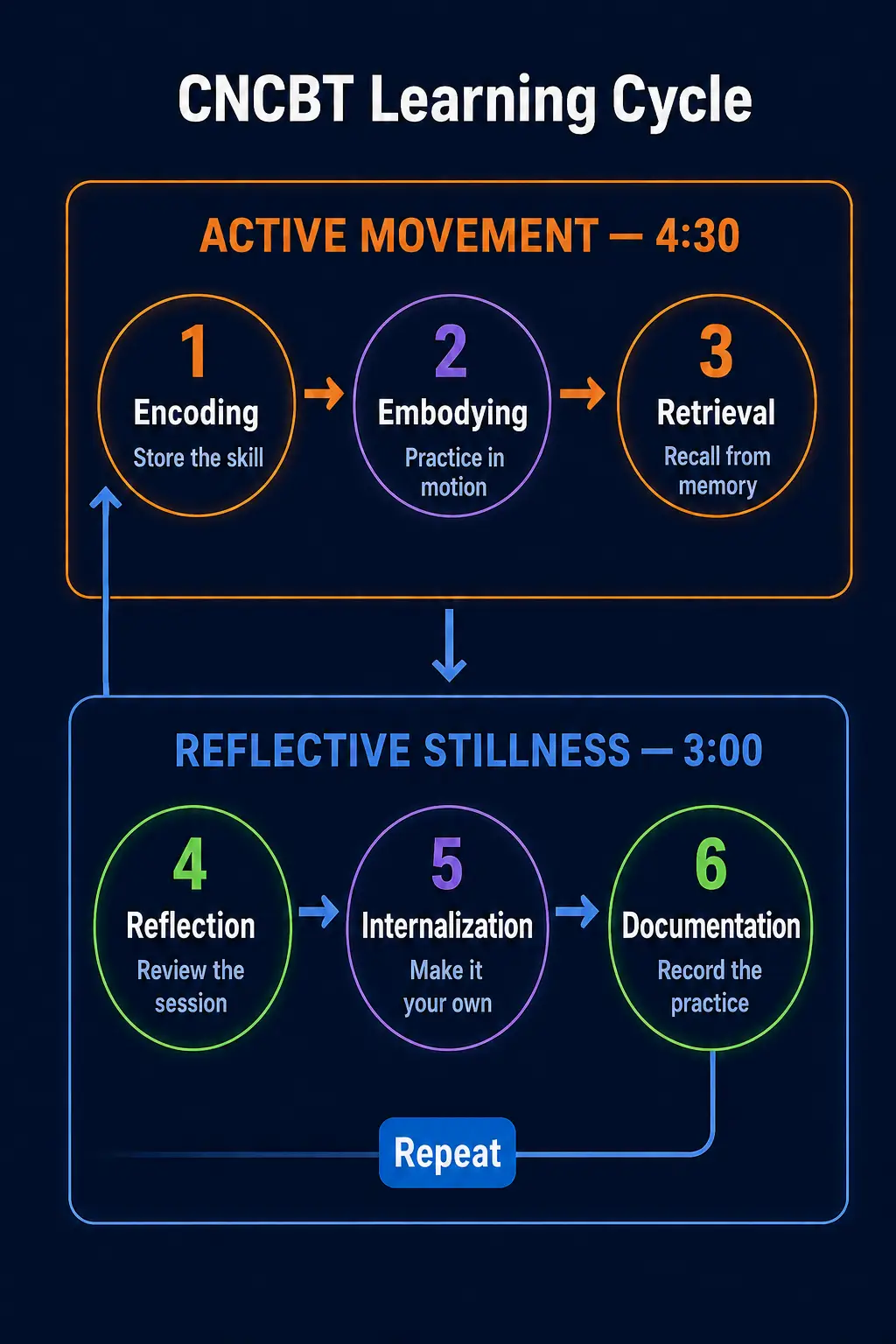
CNCBT is built on a repeated two-phase learning loop. Each 8-minute session begins with a brief preparation period, then moves through an Active Movement Phase and a Reflective Stillness Phase.

Phase 1

Active Movement Phase

This is your chosen safe exercise platform, not necessarily stairs. The goal is not the platform itself; the goal is to practice AARV(4) skills while the body is safely activated through movement.

Active Movement Learning Sequence

Encoding loads the skill into memory as a clear script or cue.

Embodying applies the skill while the body is moving, breathing, and physically activated.

Retrieval strengthens access to the skill by repeatedly pulling it back from memory during practice.

Phase 2

Reflective Stillness Phase

After movement, you slow down. This phase turns the practice into personal learning by reviewing what happened and converting the lesson into your own words.

Reflection

Identify what you noticed, what went well, where you lost focus, and what needs more practice.

Internalization

Turn the lesson into a personal cue, phrase, sequence, or next-step plan.

AARV(4) Skills

Five learning sequences for emotional
regulation and communication

The full AARV(4) sequence begins inside your own body and then moves outward into communication, validation, and constructive action.

A

Awarness

Notice activation before reacting.

A

Acceptance

Own the fight-or-flight response.

R

Relaxation

Calm the body while staying alert.

V1+V2

Active Listening + Accurate Reflection

Understand before responding.

V3+V4

Normalization + Problem-Solving

Validate what makes sense and move forward.

Foundational References

Sources and Adaptations

AARV(4) organizes established emotional-regulation, validation, and problem-solving concepts into the CNCBT movement-based learning sequence.

Awareness · Acceptance · Relaxation

Adapted from anger-management concepts and exercises presented in the Substance Abuse and Mental Health Services Administration’s group-treatment participant workbook.

SAMHSA. (2019). Anger Management for Substance Use Disorder and Mental Health Clients: Participant Workbook (PEP19-02-01-002).

V(4): Listening · Reflection · Normalization

Adapted from Marsha M. Linehan’s Dialectical Behavior Therapy validation principles, including attentive listening, accurate reflection, and communicating how a response makes sense in context.

Linehan, M. M. (2015). DBT Skills Training Manual (2nd ed.). Guilford Press.

V(4): Problem-Solving

Adapted from Donald Meichenbaum’s cognitive-behavioral problem-solving and self-instructional approach to defining problems, generating options, choosing a response, and evaluating the result.

Meichenbaum, D. (1977). Cognitive-Behavior Modification: An Integrative Approach. Plenum Press.

Adaptation note: These sources informed the skills as adapted and integrated by Richard Sohn, PsyD, for CNCBT/AARV(4) educational practice. Citation does not imply affiliation with, endorsement of, or scientific validation of CNCBT by the cited authors, publishers, or SAMHSA.

8-Minute AARV(4) Training

Practice one skill at a time

Awareness introduces the full learning model. The remaining sections follow the same rhythm without repeating the full explanation.

Awareness — First A of AARV(4)

Notice activation before reacting

Awareness is the guidance section for the full CNCBT learning loop. It teaches you how the 8-minute structure works: prepare, train through movement, then reflect and internalize.

1. Prepare & Set Intention — 0:30

Clear your intention. Quickly review the Awareness script. Start strong.

Notice the trigger, body cues, behavioral urges, emotions, and thoughts before reacting.

2. Active Movement Phase — 4:30

In this phase, you practice Awareness through three memory steps while using a safe exercise platform of your choice.

Encoding

Load the Awareness script into short-term memory as a clear cue.

Embodying

Synchronize the script with breathing, stride, posture, and body activation.

Retrieval

Pull the script back from memory repeatedly during movement.

Ask: What is happening in my body? What am I feeling? What am I thinking? What am I about to do?

3. Reflective Stillness — 3:00

Review what happened, then turn the insight into your own cue.

When I feel chest tightness, heat, or the urge to interrupt, I will pause, scan my body, name the emotion, and notice my thought before reacting.

Awareness cue

Notice before reacting.

Active Movement followed by Reflective Stillness.

Acceptance — Second A of AARV(4)

Own your response

Acceptance is not approval, agreement, or surrender. It means recognizing that emotional activation is happening inside you and choosing to take responsibility for your response.

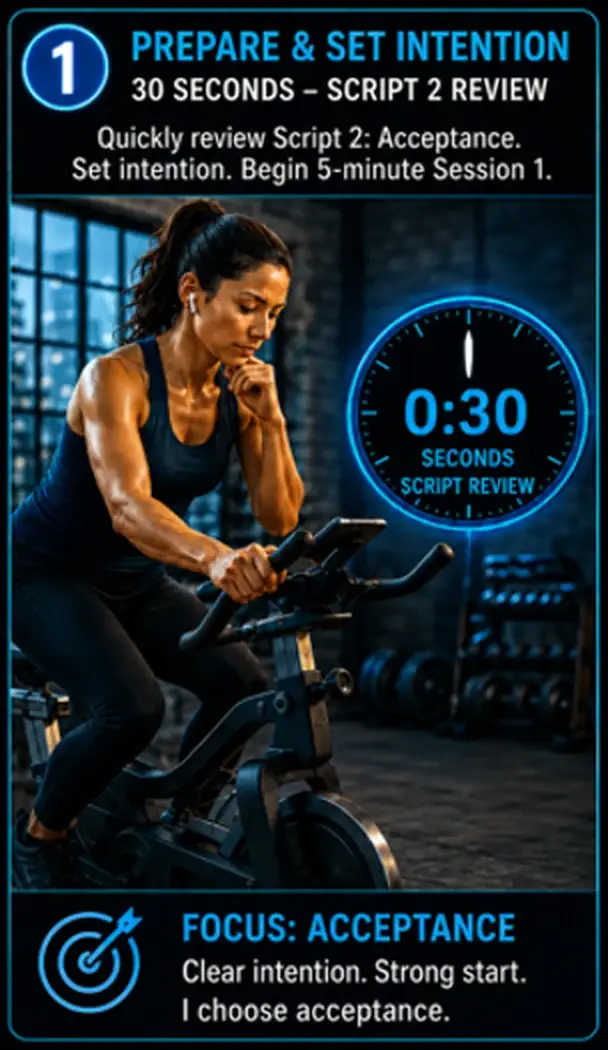
1. Prepare & Set Intention — 0:30

Quickly review the Acceptance script.

This activation is happening in me. I can own it without blaming, avoiding, or reacting automatically.

Intention: I will accept the activation and choose my next response.

2. Active Movement Phase — 4:30

Encoding

Hold the cue: My body is activated. My response is mine to manage.

Embodying

Stay with discomfort, strain, impatience, or resistance without turning it into blame.

Retrieval

Return to the cue: Own the response. Stay with the discomfort. Accept and choose.

3. Reflective Stillness — 3:00

Ask: What did I resist? What did I want to avoid? Where did I take responsibility for my own activation?

When my body activates and I want to blame someone else, I will remind myself: this is my response to manage.

Simple takeaway: This is happening in me. I can own it. I can choose.

Relaxation — R of AARV(4)

Regulate the body while staying alert

Relaxation in CNCBT does not mean becoming passive. It means calming your body enough to stay present, think clearly, and respond more effectively.

1. Prepare & Set Intention — 0:30

Slow the breath. Release tension. Ground the body. Stay steady.

Intention: I will regulate my body while staying alert and engaged.

2. Active Movement Phase — 4:30

Encoding

Hold the cue: Breathe. Release. Ground. Stay steady.

Embodying

Notice breathing rhythm, shoulders, jaw, hands, posture, and pace. Practice regulation inside activation.

Retrieval

When tension rises, retrieve: Breathe lower. Exhale longer. Release the shoulders. Stay grounded.

3. Reflective Stillness — 3:00

Ask: Where did I hold tension? What happened to my breathing? Which body cue helped me calm down?

When my breathing speeds up and my shoulders tighten, I will lengthen my exhale, relax my shoulders, ground my body, and pause before speaking.

Simple takeaway: Breathe. Release. Ground. Stay steady.

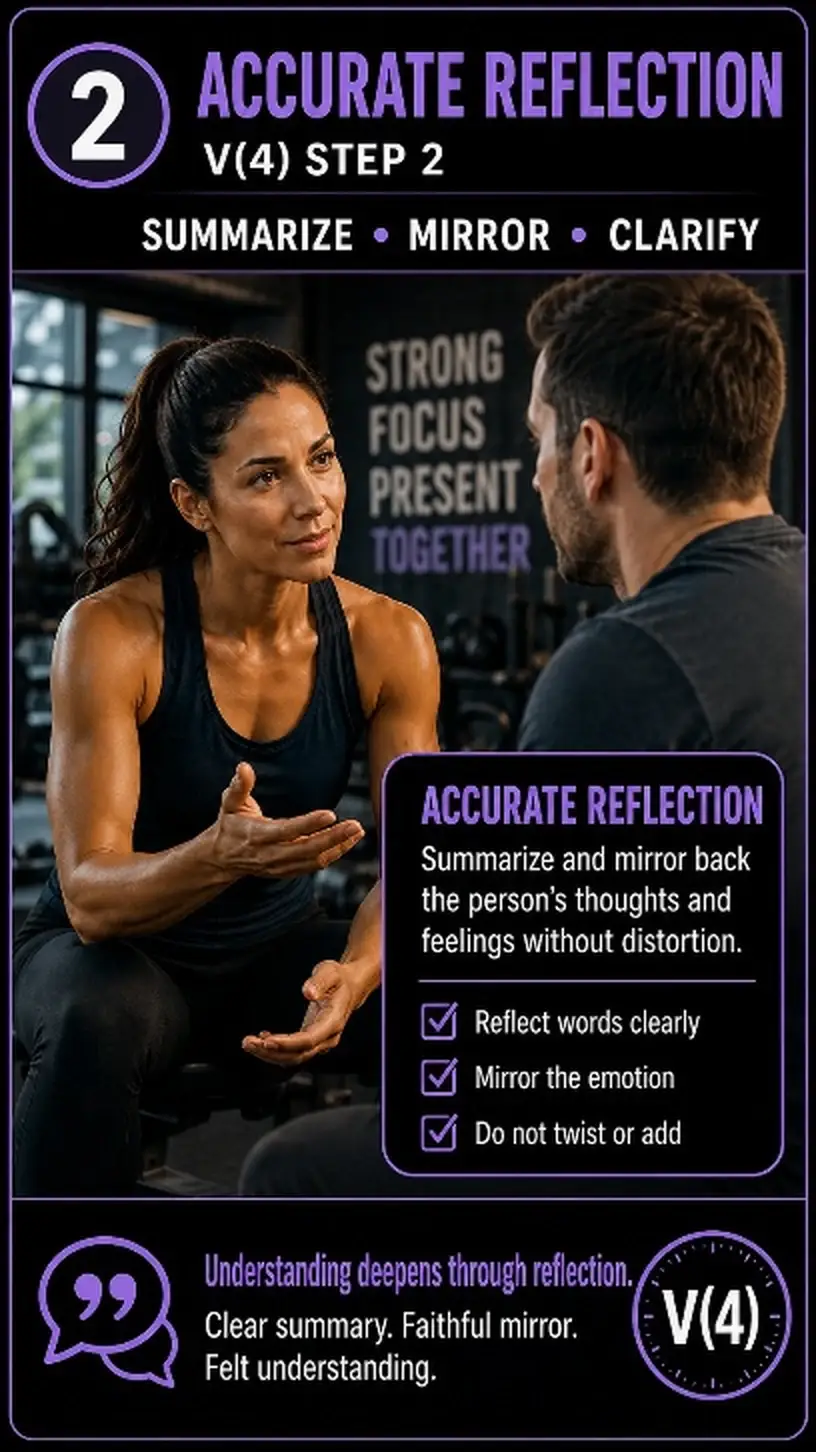
V(4), Steps 1 and 2

Active Listening + Accurate Reflection

These two skills work as one communication sequence: first listen without interrupting, defending, or preparing a comeback; then reflect the other person’s words and emotions as accurately as possible.

1. Prepare & Set Intention — 0:30

Listen first. Notice the emotion. Reflect accurately. Check understanding.

Intention: I will understand before I respond.

2. Active Movement Phase — 4:30

Encoding

Hold the cue: Listen first. Reflect before defending.

Embodying

Notice the urge to interrupt, defend, correct, or prepare your comeback. Return to a receptive listening posture.

Retrieval

When defensiveness rises, retrieve: Listen first. Reflect accurately. Check understanding.

Practice phrases

What I hear you saying is… / It sounds like you felt… / Let me make sure I understand…

3. Reflective Stillness — 3:00

Ask: Did I stay focused? Did I mentally interrupt? Did I reflect both content and emotion?

When I feel the urge to defend myself, I will pause and listen first. I will reflect the other person’s words and emotion before explaining my own position.

Simple takeaway: Listen first. Reflect clearly. Respond later.

V(4), Steps 3 and 4

Normalization + Problem-Solving

These two skills work as one relational sequence: first recognize what makes sense in context; then move toward a shared goal and one concrete next step.

1. Prepare & Set Intention — 0:30

Validate what makes sense. Find the shared goal. Choose one next step.

Intention: I will validate before I solve.

2. Active Movement Phase — 4:30

Encoding

Hold the cue: Context first. Shared goal second. Next step third.

Embodying

Practice staying balanced between empathy and action without immediately agreeing, arguing, fixing, or dismissing.

Retrieval

When the urge to dismiss or fix too quickly appears, retrieve the sequence: context, shared goal, next step.

Practice phrases

That makes sense given what happened. / What would help now? / What is one step we can take?

3. Reflective Stillness — 3:00

Ask: Did I validate before solving? Did I jump into fixing too quickly? Did I identify a shared goal?

When someone is upset, I will first acknowledge why their reaction makes sense. Then I will ask what we both want and suggest one concrete next step.

Simple takeaway: Understand the context. Find the shared goal. Take the next step.

Training App Preview

8-minute CNCBT timer

Try the basic timer here, or open the full Training App to select a platform and effort level, use optional phase cues, complete Reflective Stillness, and save or export a private practice log.

Prepare & Set Intention
08:00

Quickly review the selected skill and set your intention.

Closing Overview

CNCBT Learning Loop: Short Overview

CNCBT is built on a repeated two-phase learning loop. During the active movement phase, you practice an AARV(4) skill on a safe exercise platform of your choice. In this phase, you encode the skill, embody it through movement, and retrieve it repeatedly from memory.

After movement, the session shifts into the Reflective Stillness Phase. You slow down, review what happened, and turn the lesson into your own words, cues, or next-step plan.

Across the full AARV(4) sequence, Awareness helps you notice activation, Acceptance helps you own your response, Relaxation helps you regulate the body, Active Listening + Accurate Reflection helps you understand before responding, and Normalization + Problem-Solving helps you validate what makes sense and move toward constructive action.

In simple terms: the Active Movement Phase trains the skill; the Reflective Stillness Phase makes the skill personally usable

Safety & Educational Use

Choose safe movement and use CNCBT as education

CNCBT Academy materials are educational and based on a single-case self-study and training narrative. They are not medical advice, psychotherapy, diagnosis, or treatment.

Important Note

Educational use and physical safety

CNCBT Academy materials are for education, reflection, and skill practice. They are not a substitute for psychotherapy, medical advice, diagnosis, or treatment. The CNCBT model described here grew out of a single-case self-study and training narrative; results may vary.

Because the active movement phase can be physically demanding, choose an exercise platform that is appropriate for your health status, physical ability, and environment. Consult a qualified healthcare professional before beginning physically demanding training, and stop if you feel unsafe, dizzy, short of breath, in pain, or medically concerned.

During relational skill practice, do not use these materials to manage emergencies, abuse, dangerous conflict, or crisis situations. Seek appropriate professional, emergency, or crisis support when needed.