
Science Behind CNCBT
Why movement, memory, and behavior change belong together
This page maps the science that informs CNCBT: aerobic exercise, brain blood flow, energy metabolism, memory, neuroplasticity, and repeated cognitive-behavioral skill practice.
Educational evidence map only. CNCBT is presented as a single-case training model, not a scientifically validated treatment protocol.
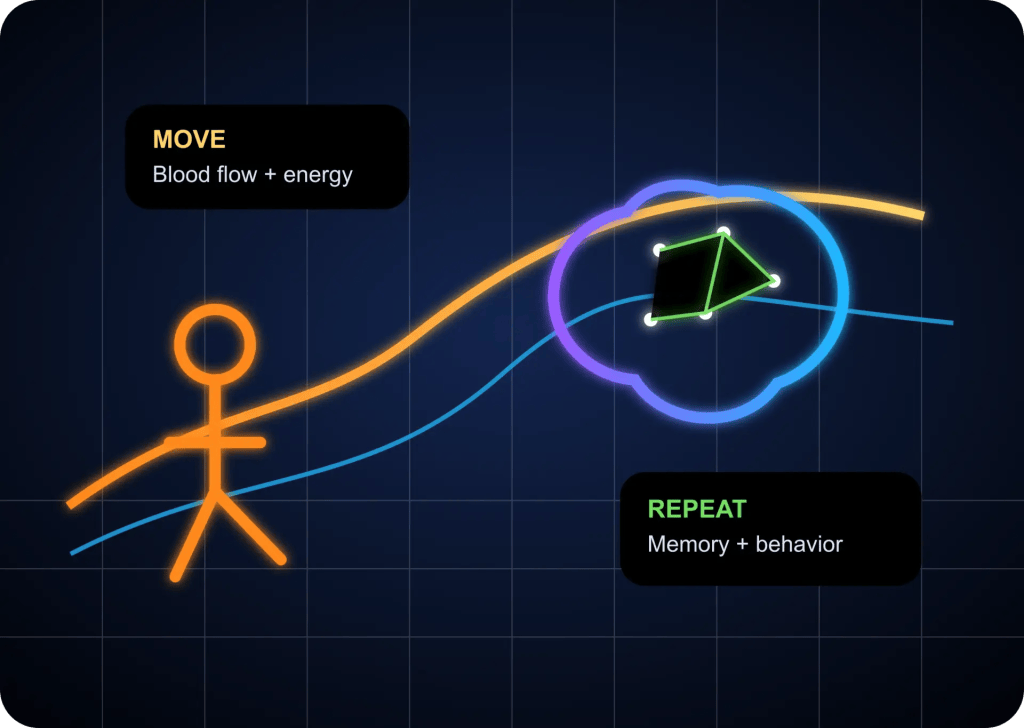
Cardio
Blood flow, oxygen, metabolic activation
Neuro
Plasticity, memory, neuron-glia energy support
CBT Skill Practice
Attention, retrieval, regulation, behavior change
On this page
Science Overview
Research themes that support the CNCBT rationale
The studies and ideas below do not prove CNCBT as a clinical treatment. They support the broader rationale that cardiovascular movement can create favorable conditions for attention, memory, skill learning, and emotional-regulation practice.
01
Cardio Builds The Brain
Aerobic exercise may support brain function through blood flow, oxygen delivery, BDNF-related processes, hippocampal health, lactate, and stress resilience.
02
Stronger Blood Flow, Stronger Brain
Higher aerobic fitness is associated with better cerebrovascular reserve, blood-flow regulation, and cognitive performance during demanding tasks.
03
Sharper Thinking, Better Decisions
Exercise is linked to executive functions such as attention, cognitive control, planning, problem-solving, and flexible thinking.
04
Environment And Repetition Rewire The Brain
Enriched environments, deliberate practice, repetition, and energy support help explain why repeated movement-based learning may become more durable.
EVIDENCE MAP
Study Cards By Theme
Cardio Builds The Brain
Regular aerobic exercise may improve brain function through increased blood flow, oxygen and nutrient delivery, and adaptive processes such as BDNF activity, neurogenesis, and angiogenesis.
CNCBT Link:
Cardiovascular movement may help prepare the brain for attention, memory, and skill learning.
Hippocampus And Memory
Regular aerobic exercise was associated with increased hippocampal volume and improved memory performance.
CNCBT Link:
Exercise may support the memory systems needed to learn, retain, and retrieve AARV(4) skills.
Resilience, Lactate, And Adaptation
Vigorous aerobic exercise may increase growth factors and lactate while reducing inflammation and oxidative stress.
CNCBT Link:
Moderately vigorous to vigorous movement may support a more adaptable brain environment for emotional-regulation practice.
Cerebrovascular Reserve
Higher aerobic fitness is associated with stronger cerebrovascular reserve, vascular conductance, and brain blood-flow regulation.
CNCBT Link:
Improved circulation may support attention, learning, memory, and decision-making during skill practice.
Young Adult Cognition
Higher aerobic fitness in healthy young adults is associated with stronger performance on complex cognitive tasks and stronger cerebrovascular reactivity.
CNCBT Link:
Aerobic movement may support skill learning across the lifespan, not only in older adults.
Higher-order Thinking
Improved cardiorespiratory fitness was associated with better reasoning, problem-solving, planning, and flexible thinking.
CNCBT Link:
AARV(4) skill use depends on the same higher-order abilities: attention, planning, and intentional choice.
Executive Functions
Regular physical exercise is associated with stronger attention, cognitive control, planning, and decision-making.
CNCBT Link:
Emotional regulation requires the ability to pause, focus, resist impulses, and choose a response.
Enriched Environment
Movement, exploration, learning, and stimulation can strengthen brain structures and support learning and memory.
CNCBT Link:
CNCBT combines exercise, cognitive challenge, and behavioral rehearsal into an enriched learning environment.
Neuron-glia Energy Support
Brain performance depends on energy delivery systems, including astrocyte-neuron cooperation and lactate support for active cells.
CNCBT Link:
Cardio may support the energy environment needed for attention, memory, and repeated skill practice.
Cardio Builds The Brain
Regular aerobic exercise may improve brain function through increased blood flow, oxygen and nutrient delivery, and adaptive processes such as BDNF activity, neurogenesis, and angiogenesis.
CNCBT Link:
Moderately vigorous to vigorous movement may support a more adaptable brain environment for emotional-regulation practice.
Hippocampus And Memory
Regular aerobic exercise was associated with increased hippocampal volume and improved memory performance.
CNCBT Link:
Exercise may support the memory systems needed to learn, retain, and retrieve AARV(4) skills.
Resilience, Lactate, And Adaptation
Vigorous aerobic exercise may increase growth factors and lactate while reducing inflammation and oxidative stress.
CNCBT Link:
Moderately vigorous to vigorous movement may support a more adaptable brain environment for emotional-regulation practice.
Enriched Environment
Movement, exploration, learning, and stimulation can strengthen brain structures and support learning and memory.
CNCBT Link:
CNCBT combines exercise, cognitive challenge, and behavioral rehearsal into an enriched learning environment.
Neuron-glia Energy Support
Brain performance depends on energy delivery systems, including astrocyte-neuron cooperation and lactate support for active cells.
CNCBT Link:
Cardio may support the energy environment needed for attention, memory, and repeated skill practice.
Cardio Builds The Brain
Regular aerobic exercise may improve brain function through increased blood flow, oxygen and nutrient delivery, and adaptive processes such as BDNF activity, neurogenesis, and angiogenesis.
CNCBT Link:
Cardiovascular movement may help prepare the brain for attention, memory, and skill learning.
Cerebrovascular Reserve
Higher aerobic fitness is associated with stronger cerebrovascular reserve, vascular conductance, and brain blood-flow regulation.
CNCBT Link:
Improved circulation may support attention, learning, memory, and decision-making during skill practice.
Young Adult Cognition
Higher aerobic fitness in healthy young adults is associated with stronger performance on complex cognitive tasks and stronger cerebrovascular reactivity.
CNCBT Link:
Aerobic movement may support skill learning across the lifespan, not only in older adults.
Hippocampus And Memory
Regular aerobic exercise was associated with increased hippocampal volume and improved memory performance.
CNCBT Link:
Exercise may support the memory systems needed to learn, retain, and retrieve AARV(4) skills.
Cerebrovascular Reserve
Higher aerobic fitness is associated with stronger cerebrovascular reserve, vascular conductance, and brain blood-flow regulation.
CNCBT Link:
Improved circulation may support attention, learning, memory, and decision-making during skill practice.
Young Adult Cognition
Higher aerobic fitness in healthy young adults is associated with stronger performance on complex cognitive tasks and stronger cerebrovascular reactivity.
CNCBT Link:
Aerobic movement may support skill learning across the lifespan, not only in older adults.
Higher-order Thinking
Improved cardiorespiratory fitness was associated with better reasoning, problem-solving, planning, and flexible thinking.
CNCBT Link:
AARV(4) skill use depends on the same higher-order abilities: attention, planning, and intentional choice.
Executive Functions
Regular physical exercise is associated with stronger attention, cognitive control, planning, and decision-making.
CNCBT Link:
Emotional regulation requires the ability to pause, focus, resist impulses, and choose a response.
Resilience, Lactate, And Adaptation
Vigorous aerobic exercise may increase growth factors and lactate while reducing inflammation and oxidative stress.
CNCBT Link:
Cardiovascular movement may help prepare the brain for attention, memory, and skill learning.
Enriched Environment
Movement, exploration, learning, and stimulation can strengthen brain structures and support learning and memory.
CNCBT Link:
CNCBT combines exercise, cognitive challenge, and behavioral rehearsal into an enriched learning environment.
Neuron-glia Energy Support
Brain performance depends on energy delivery systems, including astrocyte-neuron cooperation and lactate support for active cells.
CNCBT Link:
Cardio may support the energy environment needed for attention, memory, and repeated skill practice.
Brain Built to Move
Movement was never separate from thinking and survival
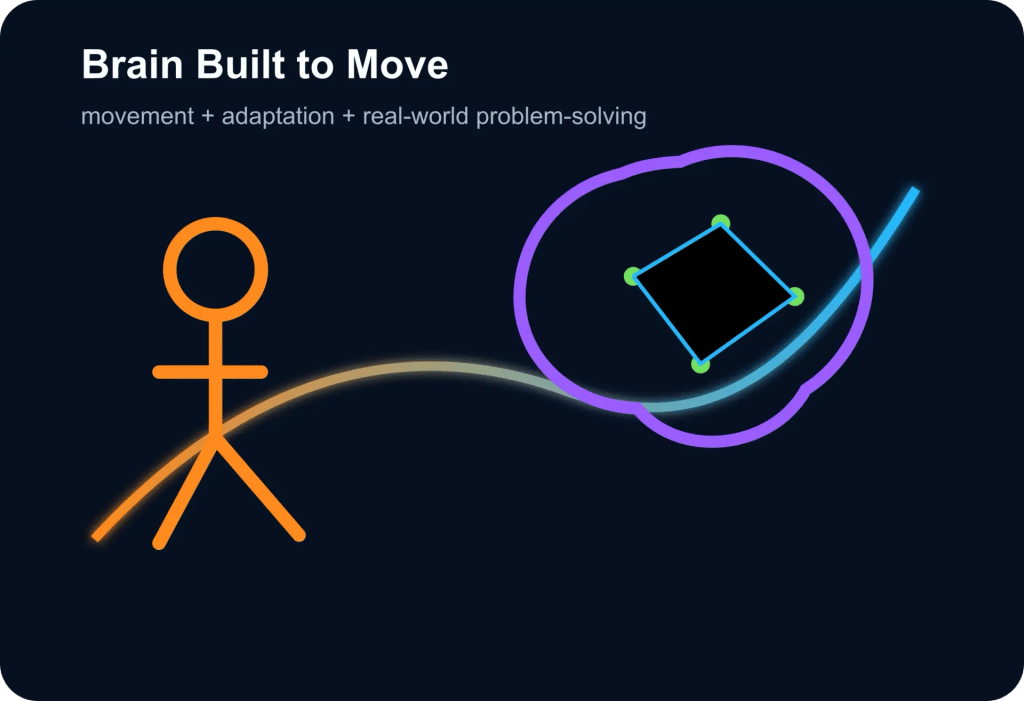
CNCBT uses movement as a training context because human thinking, navigation, adaptation, and survival have long been linked with bodily effort.
An energy-hungry brain
As brain capacity expanded, humans paid a high energy cost. CNCBT uses this idea to emphasize that the brain depends on steady biological support, not isolated thinking alone.
Movement as a cognitive environment
Walking, climbing, navigating, searching, and problem-solving were historically linked. Movement was not merely exercise; it was part of the environment in which cognition developed.
The evolutionary performance envelope
John Medina’s evolutionary-performance-envelope idea helps frame CNCBT: the brain may work well when thinking is connected to movement, adaptation, and real-world problem-solving.
A Nobel Prize Lesson
Learn the brain one small unit at a time
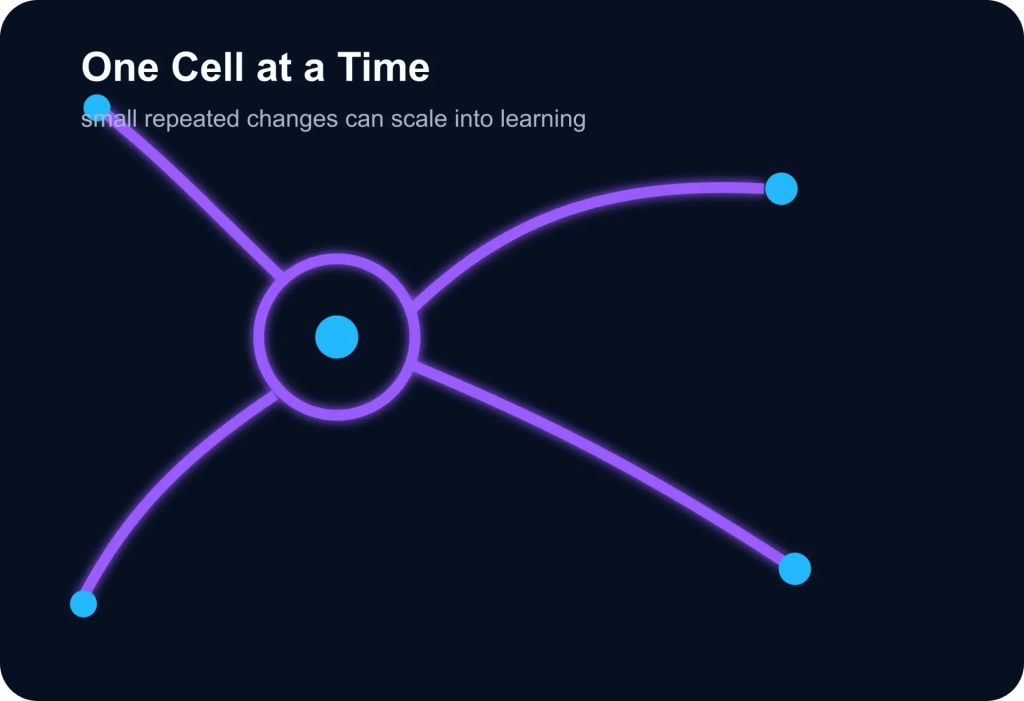
Eric Kandel’s work helped show that learning and memory can be studied through simple systems, cells, and synaptic connections. For CNCBT, this becomes a practical lesson: behavior change is built through repeated small learning units.
Reductionism works
Study the complex by breaking it down into smaller, trainable parts.
The Aplysia breakthrough
Simple nervous systems can reveal principles of learning and memory.
Learning lives in connection
Memory is shaped by changes in the strength and efficiency of connections.
From cell to behavior
Repeated cellular changes can scale upward into learning, memory, and behavior.
Cells That Fire Together Wire Together
Repetition makes the pathway easier to use
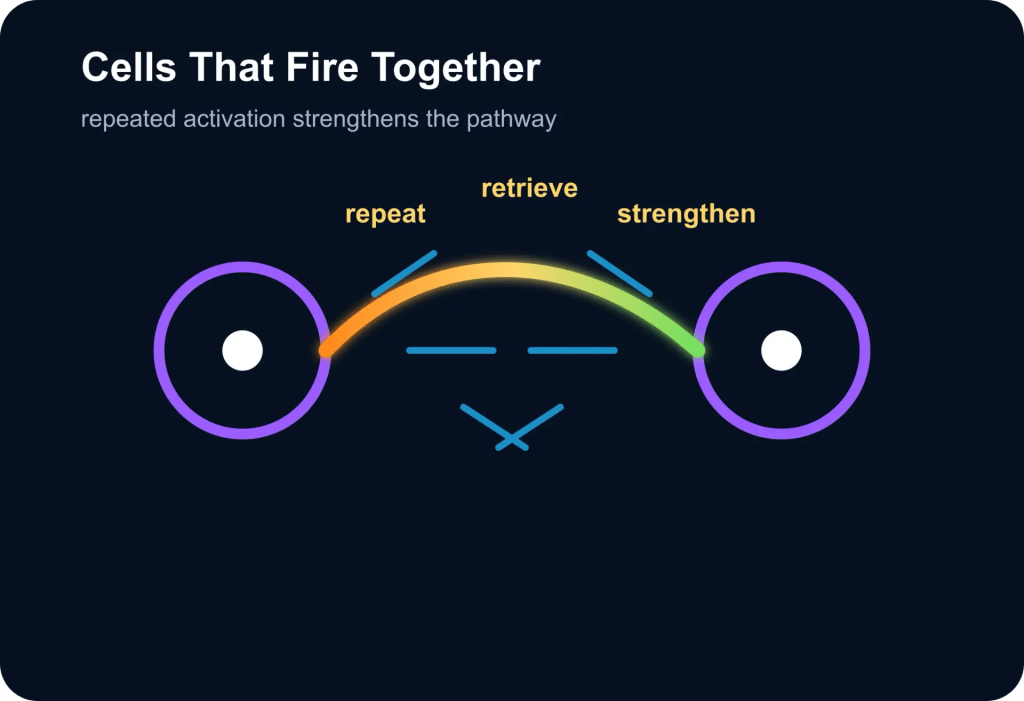
Hebbian learning is often summarized as: neurons that fire together wire together. In plain language, repeated patterns of activation can make a connection more efficient and more likely to be used again.
1. Movement primes the cell to learn
A safe movement platform raises physiological activation and may increase blood flow, oxygen delivery, and metabolic support. CNCBT uses that activated state as the training environment.
2. Cognitive challenge builds stronger connections
The learner does not only move. The learner encodes, rehearses, retrieves, reflects, and internalizes a skill. That combination turns physical effort into a learning task.
3. Repetition makes it last
Each repetition gives the skill another chance to become easier to recall. Over time, the goal is for AARV(4) skills to become more available during real emotional activation.
The Bottom Line
Rewire Emotions in Motion
CNCBT brings together body activation, brain readiness, cognitive challenge, and repeated behavioral rehearsal. The science page explains why this combination is plausible as a training model, while still recognizing the limits of a single-case self-study.
Prepare the body and brain
Cardio can create the internal conditions for alertness, blood flow, energy use, and attention.
Practice thinking under activation
CNCBT trains skill retrieval while the body is activated, making practice more demanding and more realistic.
Turn knowledge into habit
Repetition, reflection, and internalization help move skills from intellectual understanding toward personally usable behavior.
Science page publishing note
Before publication, replace abbreviated author-year references with full citation details and confirm the wording of all study claims. Keep the language educational and avoid implying that CNCBT has already been scientifically validated as a treatment.